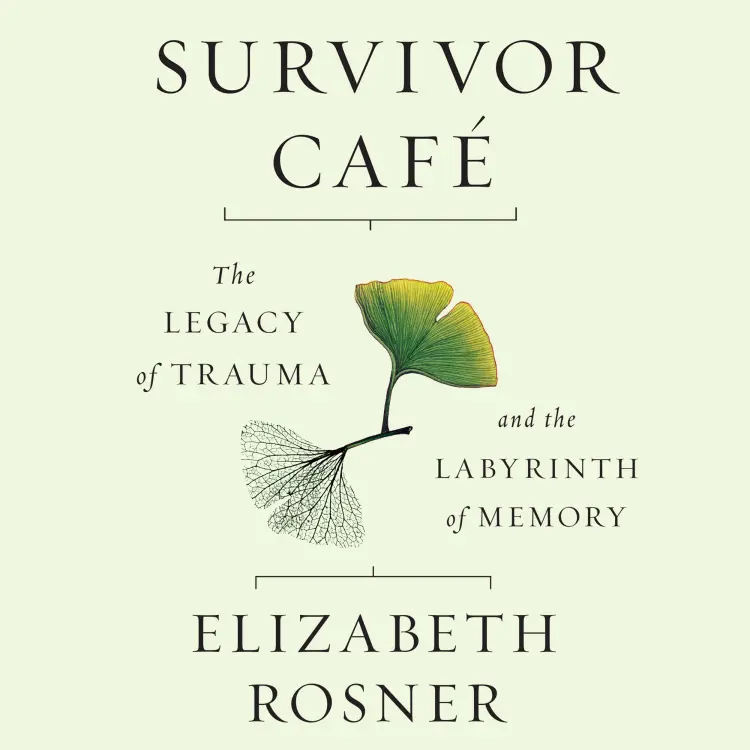
Survivor Café - The Legacy of Trauma and the Labyrinth of Memory
Elizabeth Rosner
Unabridged
9 hours 14 minutes
Note: Costs may be incurred for playing the audio books or audio plays on the respective platforms, e.g. Spotify. Lismio has no influence on which audiobooks and audio plays are available on the service.
Some articles contain affiliate links (marked with an asterisk *). If you click on these links and purchase products, we will receive a small commission at no extra cost to you. Your support helps to keep this site running and to continue creating useful content. Thank you for your support!
From the publisher
As firsthand survivors of many of the twentieth century's most monumental events-the Holocaust, Pearl Harbor, the Killing Fields-begin to pass away, Survivor Café addresses urgent questions: How do we carry those stories forward? How do we collectively ensure that the horrors of the past are not forgotten?
Elizabeth Rosner organizes her book around three trips with her father to Buchenwald concentration camp-in 1983, in 1995, and in 2015-each journey an experience in which personal history confronts both commemoration and memorialization. She explores the echoes of similar legacies among descendants of African American slaves, descendants of Cambodian survivors of the Killing Fields, descendants of survivors of the bombing of Hiroshima and Nagasaki, and the effects of 9/11 on the general population. Examining current brain research, Rosner depicts the efforts to understand the intergenerational inheritance of trauma, as well as the intricacies of remembrance in the aftermath of atrocity. Survivor Café becomes a lens for numerous constructs of memory-from museums and commemorative sites to national reconciliation projects to small-group cross-cultural encounters.
Beyond preserving the firsthand testimonies of participants and witnesses, individuals and societies must continually take responsibility for learning the painful lessons of the past in order to offer hope for the future. Survivor Café offers a clear-eyed sense of the enormity of our twenty-first-century human inheritance-not only among direct descendants of the Holocaust but also in the shape of our collective responsibility to learn from tragedy, and to keep the ever-changing conversations alive between the past and the present.
Elizabeth Rosner organizes her book around three trips with her father to Buchenwald concentration camp-in 1983, in 1995, and in 2015-each journey an experience in which personal history confronts both commemoration and memorialization. She explores the echoes of similar legacies among descendants of African American slaves, descendants of Cambodian survivors of the Killing Fields, descendants of survivors of the bombing of Hiroshima and Nagasaki, and the effects of 9/11 on the general population. Examining current brain research, Rosner depicts the efforts to understand the intergenerational inheritance of trauma, as well as the intricacies of remembrance in the aftermath of atrocity. Survivor Café becomes a lens for numerous constructs of memory-from museums and commemorative sites to national reconciliation projects to small-group cross-cultural encounters.
Beyond preserving the firsthand testimonies of participants and witnesses, individuals and societies must continually take responsibility for learning the painful lessons of the past in order to offer hope for the future. Survivor Café offers a clear-eyed sense of the enormity of our twenty-first-century human inheritance-not only among direct descendants of the Holocaust but also in the shape of our collective responsibility to learn from tragedy, and to keep the ever-changing conversations alive between the past and the present.
From the same authors

Novel Audio
-
Cover - Lawrence Levy - To Pixar and Beyond - My Unlikely Journey With Steve Jobs to Make Entertainment History
 Lawrence Levy: To Pixar and Beyond - My Unlikely Journey With Steve Jobs to Make Entertainment HistoryTo Pixar and Beyond - My Unlikely Journey With Steve Jobs to Make Entertainment HistoryLawrence Levy
 -
Cover - Darryl Ponicsán - Last Flag Flying
 Darryl Ponicsán: Last Flag FlyingLast Flag FlyingDarryl Ponicsán
 -
Cover - R.S. Grey - The Beau & the Belle
 R.S. Grey: The Beau & the BelleThe Beau & the BelleR.S. Grey
 -
Cover - Nicolette Hahn Niman - Defending Beef - The Case for Sustainable Meat Production
 Nicolette Hahn Niman: Defending Beef - The Case for Sustainable Meat ProductionDefending Beef - The Case for Sustainable Meat ProductionNicolette Hahn Niman
 -
Cover - James C. Hunter - The Servant - A Simple Story About the True Essence of Leadership
 James C. Hunter: The Servant - A Simple Story About the True Essence of LeadershipThe Servant - A Simple Story About the True Essence of LeadershipJames C. Hunter
 -
Cover - Anthony M. Amore - The Art of the Con - The Most Notorious Fakes, Frauds, and Forgeries in the Art World
 Anthony M. Amore: The Art of the Con - The Most Notorious Fakes, Frauds, and Forgeries in the Art WorldThe Art of the Con - The Most Notorious Fakes, Frauds, and Forgeries in the Art WorldAnthony M. Amore
