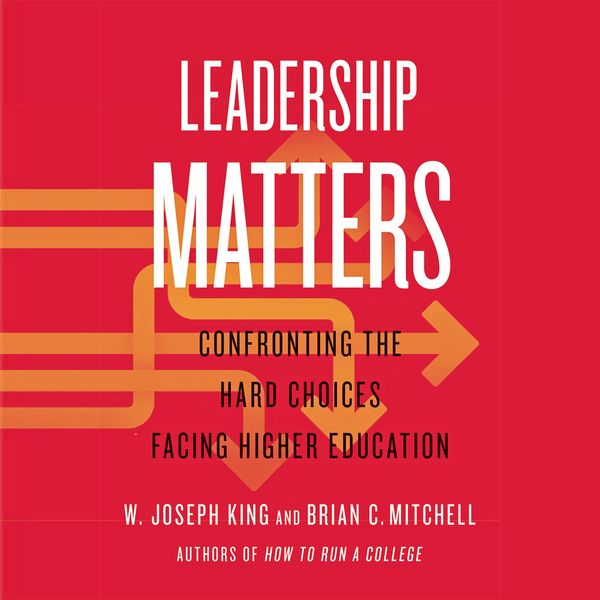
Leadership Matters
W. Joseph King , Brian C. Mitchell
Unabridged
•
9781421451053
6 hours

Some articles contain affiliate links (marked with an asterisk *). If you click on these links and purchase products, we will receive a small commission at no extra cost to you. Your support helps to keep this site running and to continue creating useful content. Thank you for your support!
From the publisher
During these unprecedented times, glaring internal inefficiencies, communication breakdowns, and an overriding sense of cultural inertia on many campuses are too often set against a backdrop of changing consumer preferences, high sticker prices, declining demand, massive tuition discounting, aging infrastructure, technological and pedagogical alternatives, and political pressure. Strategic leadership in such a complex environment needs to be exercised in nuanced ways that differ from those embraced by corporate cultures. In Leadership Matters, W. Joseph King and Brian C. Mitchell argue that the success of higher education institutions depends on strategic leaders who can utilize the strengths of their institutions and leaders to balance internal pressures, shifting demographics, global education needs, and workforce preparation demands beyond the college gates. Drawing on their extensive experience, the authors guide senior administration, trustees, and presidents on how to lead during immense financial, demographic, and social challenges. King and Mitchell believe that, to survive, colleges must be well run—flexible, effective, and forward thinking. The authors begin with a fundamental premise—that colleges and universities must evolve and adapt by modernizing their practices, monetizing their assets, focusing on core educational strategies, and linking explicitly to the modern world. Discussing a broad range of leadership positions, including presidents, provosts, and board chairs, Leadership Matters touches on strategic planning, management and operations, stakeholder relations, campus and community, accreditation and athletic conferences, and much more. The authors offer an optimistic assessment based upon frank and stark conclusions about what colleges must do—and must not do—to remain relevant in the coming decades.
From the same authors


Johns Hopkins University Press
-
Cover - Anthony Feinstein - Mind, Mood, and Memory
 Anthony Feinstein: Mind, Mood, and MemoryMind, Mood, and MemoryAnthony Feinstein
 -
Cover - Bryan Alexander - Universities on Fire
 Bryan Alexander: Universities on FireUniversities on FireBryan Alexander
 -
Cover - Rebecca Pope-Ruark - Unraveling Faculty Burnout
 Rebecca Pope-Ruark: Unraveling Faculty BurnoutUnraveling Faculty BurnoutRebecca Pope-Ruark
 -
Cover - Jonathan Zimmerman - The Amateur Hour
 Jonathan Zimmerman: The Amateur HourThe Amateur HourJonathan Zimmerman
 -
Cover - Martin F. Shapiro - The Present Illness
 Martin F. Shapiro: The Present IllnessThe Present IllnessMartin F. Shapiro