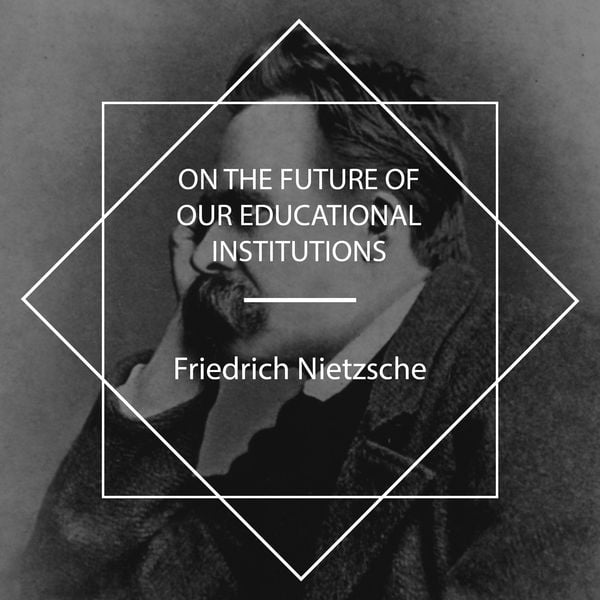
On the Future of Our Educational ...
Friedrich Nietzsche
Onverkort
•
4061707875564
4 uur 53 minuten

Sommige artikelen bevatten affiliate links (gemarkeerd met een sterretje *). Als je op deze links klikt en producten koopt, ontvangen we een kleine commissie zonder extra kosten voor jou. Uw steun helpt ons deze site draaiende te houden en nuttige inhoud te blijven maken. Hartelijk dank voor uw steun!
Van de uitgever
In 1869, at the age of twenty-five, the precociously brilliant Friedrich Nietzsche was appointed to a professorship of classical philology at the University of Basel. He seemed marked for a successful and conventional academic career. Then the philosophy of Schopenhauer and the music of Wagner transformed his sense of purpose. The genius of such thinkers and makers—like the genius of the ancient Greeks—was the only touchstone for true understanding. How then was education to answer to such genius? Something more than sturdy scholarship was called for. A new way of teaching and questioning, a new philosophy... What that new way might be was the question Nietzsche broached in five vivid, popular public lectures in Basel in 1872. Composed in emulation (and to some degree as a satire) of a Platonic dialogue, Anti-Education presents a provocative and timely reckoning with what remains one of the great problems of modern societies.
Van dezelfde auteurs


Erika
-
Cover - Charles Dickens - Juffrouw Lirriper en haar Commensalen
 Charles Dickens: Juffrouw Lirriper en haar CommensalenJuffrouw Lirriper en haar CommensalenCharles Dickens
 -
Cover - Charles Dickens - The Mystery of Edwin Drood
 Charles Dickens: The Mystery of Edwin DroodThe Mystery of Edwin DroodCharles Dickens
 -
Cover - Charles Dickens - De Gevaren van Sommige Engelse ...
 Charles Dickens: De Gevaren van Sommige Engelse ...De Gevaren van Sommige Engelse ...Charles Dickens
 -
Cover - Charles Dickens - Het Geheim van Edwin Drood
 Charles Dickens: Het Geheim van Edwin DroodHet Geheim van Edwin DroodCharles Dickens
 -
Cover - Charles Dickens - Christmas Books
 Charles Dickens: Christmas BooksChristmas BooksCharles Dickens