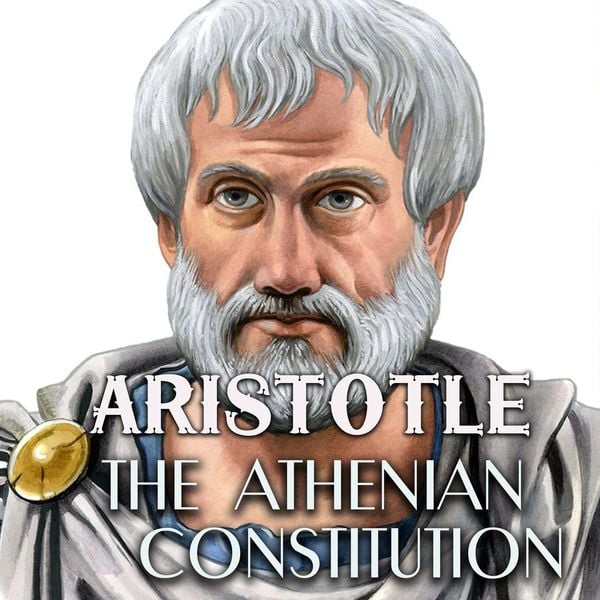
The Athenian Constitution
Aristotle
Onverkort
•
4099995200720
2 uur 35 minuten

Sommige artikelen bevatten affiliate links (gemarkeerd met een sterretje *). Als je op deze links klikt en producten koopt, ontvangen we een kleine commissie zonder extra kosten voor jou. Uw steun helpt ons deze site draaiende te houden en nuttige inhoud te blijven maken. Hartelijk dank voor uw steun!
Van de uitgever
The Constitution of the Athenians, also called the Athenian Constitution (Greek: Ἀθηναίων πολιτεία, Athenaion Politeia; Latin: Atheniensium Respublica), is a work by Aristotle or one of his students. The work describes the constitution of Athens. It is preserved on a papyrus roll from Hermopolis, published in 1891 and now in the British Library. A small part of the work also survives on two leaves of a papyrus codex, discovered in the Fayum in 1879 and now in the papyrus collection of the Ägyptisches Museum in Berlin. The Constitution of the Athenians (in ancient Greek Ἀθηναίων πολιτεία, Athenaion Politeia) describes the political system of ancient Athens. According to ancient sources, Aristotle compiled constitutions of 158 Greek states, of which the Constitution of the Athenians is the only one to survive intact. Modern scholars dispute how much of the authorship of these constitutions can be attributed to Aristotle personally; he at least would have been assisted by his students. The work consists of two parts. The first part, deals with the different forms of the constitution, from the trial of the Alcmaeonidae until the fall of the Thirty and the restoration of democracy in 403 BC. The lost beginning, which is not preserved on the London papyrus but survives only in a handful of citations in ancient sources and in the epitome of Heraclides Lembus, dealt with the migration of Ion to Athens, the creation of phylai, trittyes and phratries, the kingship of Pandion, the democratic reform of Theseus, the death of Theseus, the change from a monarchy to a system with elected archons under the Codrid dynasty, the cruelty of Hippomenes and the conspiracy of Cylon. The second part describes the city's institutions, including the terms of access to citizenship, magistrates, and the courts.
Van dezelfde auteurs


Strelbytskyy Multimedia Publishing
-
Cover - A. S. Pushkin - Baryishnya-krestyanka
 A. S. Pushkin: Baryishnya-krestyankaBaryishnya-krestyankaA. S. Pushkin
 -
Cover - Alexander Pushkin - Istoriya Pugachyova
 Alexander Pushkin: Istoriya PugachyovaIstoriya PugachyovaAlexander Pushkin
 -
Cover - Alexander Pushkin - Pesn' o veschem Olege
 Alexander Pushkin: Pesn' o veschem OlegePesn' o veschem OlegeAlexander Pushkin
 -
Cover - Taras Shevchenko - Kobzar. Za vydannyam 1840 roku taras ...
 Taras Shevchenko: Kobzar. Za vydannyam 1840 roku taras ...Kobzar. Za vydannyam 1840 roku taras ...Taras Shevchenko
 -
Cover - Alexander Pushkin - Roman v pismah
 Alexander Pushkin: Roman v pismahRoman v pismahAlexander Pushkin