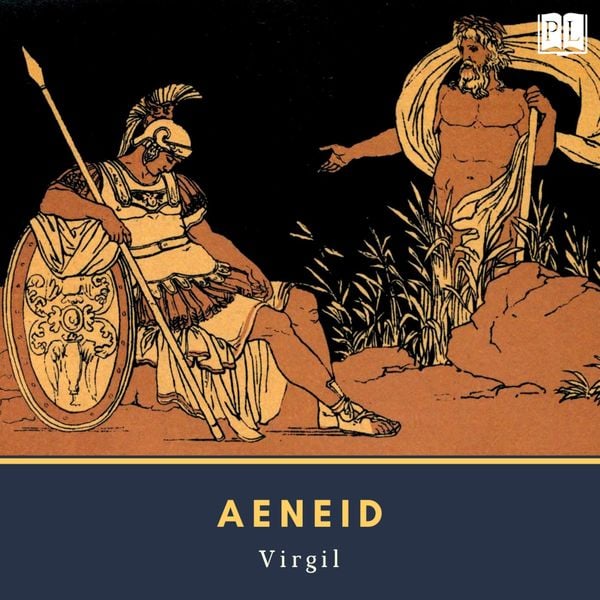
Aeneid
Virgil
Onverkort
•
4064066674212
12 uur 57 minuten

Sommige artikelen bevatten affiliate links (gemarkeerd met een sterretje *). Als je op deze links klikt en producten koopt, ontvangen we een kleine commissie zonder extra kosten voor jou. Uw steun helpt ons deze site draaiende te houden en nuttige inhoud te blijven maken. Hartelijk dank voor uw steun!
Van de uitgever
The Aeneid (Latin: Aeneis) is a Latin epic poem, written by Virgil between 29 and 19 BC, that tells the legendary story of Aeneas, a Trojan who travelled to Italy, where he became the ancestor of the Romans. It comprises 9,896 lines in dactylic hexameter. The first six of the poem's twelve books tell the story of Aeneas's wanderings from Troy to Italy, and the poem's second half tells of the Trojans' ultimately victorious war upon the Latins, under whose name Aeneas and his Trojan followers are destined to be subsumed. The hero Aeneas was already known to Greco-Roman legend and myth, having been a character in the Iliad. Virgil took the disconnected tales of Aeneas's wanderings, his vague association with the foundation of Rome and his description as a personage of no fixed characteristics other than a scrupulous pietas, and fashioned the Aeneid into a compelling founding myth or national epic that tied Rome to the legends of Troy, explained the Punic Wars, glorified traditional Roman virtues, and legitimized the Julio-Claudian dynasty as descendants of the founders, heroes, and gods of Rome and Troy. The Aeneid is widely regarded as Virgil's masterpiece and one of the greatest works of Latin literature.
Van dezelfde auteurs


Parolita Libro
-
Cover - Arthur Conan Doyle - Sherlock Holmes - The Novels
 Arthur Conan Doyle: Sherlock Holmes - The NovelsSherlock Holmes - The NovelsArthur Conan Doyle
 -
Cover - William Shakespeare - Love's Labour's Lost
 William Shakespeare: Love's Labour's LostSeriesLove's Labour's LostWilliam Shakespeare
 -
Cover - Lucy Maud Montgomery - Emily's Quest
 Lucy Maud Montgomery: Emily's QuestSeriesEmily's QuestLucy Maud Montgomery
 -
Cover - Fyodor Dostoevsky - The House of the Dead
 Fyodor Dostoevsky: The House of the DeadThe House of the DeadFyodor Dostoevsky
 -
Cover - William Shakespeare - Much Ado About Nothing
 William Shakespeare: Much Ado About NothingSeriesMuch Ado About NothingWilliam Shakespeare